
Victor Koech
March 8, 2024
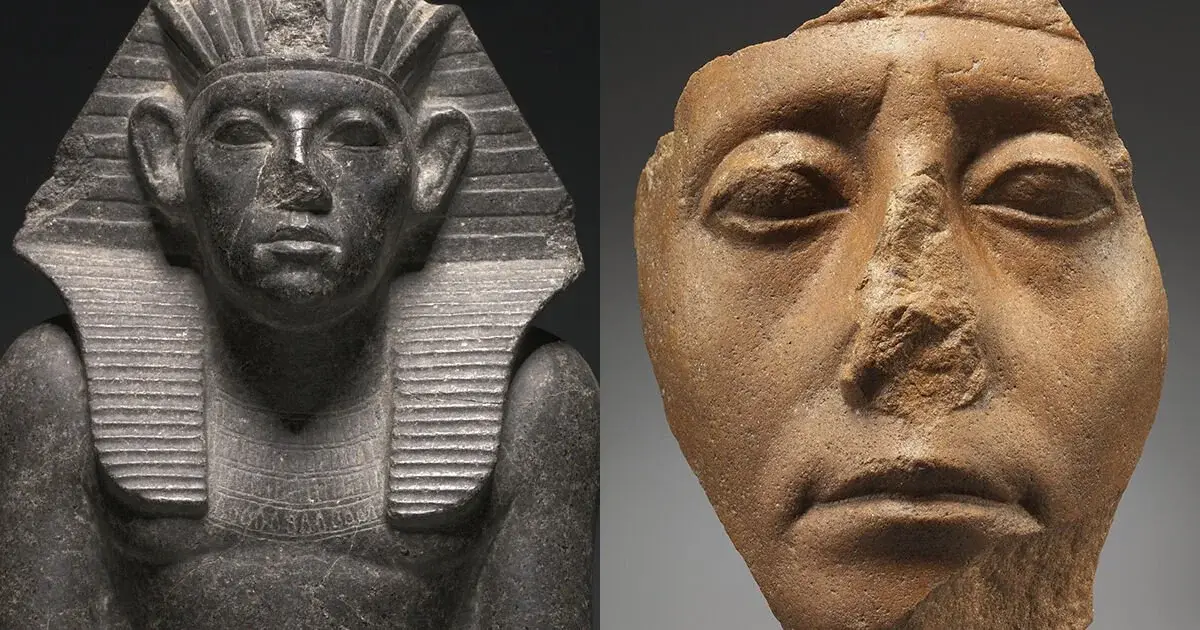
Many of the noses that you see on Egyptian statues, whether they are in exhibits, in museums or in Egypt are gone. And it’s not because they disintegrated, it’s because they were removed by other early Christians or the Muslims after 640 A.D.
Remember, if you change the image of an individual, you no longer have an actual image of a human being like when you remove the nose. That was the perception of the time. So, that’s why approximately 95% of all Egyptian statutes that had noses no longer do.
Many of the likenesses of those with African features were destroyed by European invaders and Asian invaders, but more specifically European invaders or when the nose didn’t look the way that they thought it should look, the nose suddenly got broken. It’s strange that the Romans and the Greeks who had more pointed nose when you go to Alexandria and that part of the museum, not a single nose is broken.
In the book Russian Icons by Father Vladimir Ivanov, recently discovered, we find the most interesting collection of Christian icons. It is of high interest for two reasons. No. 1, it depicts the various Christian icons as black and No. 2 this is not found in Western Europe but well in Eastern Europe and Russia. This means that black people were venerated as deities from Spain to France, Italy, Germany and all the way to Russia; in some, all over Europe.
There are at least 500 Black Madonnas in Europe, not counting the ones hidden in the Vatican, 128 are in France alone. And you need to remember that these icons survived multiple waves of iconoclasm. This means that in the past, they would have been ubiquitous throughout Europe before the great artists like Michelangelo and Leonardo were commissioned to start painting the classic Europeanised face of Jesus that we know today.
Today, it has become common knowledge that that the white depiction of Jesus is false. With little Biblical research, we know Jesus was from the tribe of Judah, which was the Bluest Blackest of the twelve tribes. They were known for their nappy hair and purple skin.
Jesus’ mother hid Him in Kemmet, the present-day Egypt. In the early period of Egypt, during the Old Kingdom, Egypt was referred to as Kemet (Kermit), or simply Kmt, which means the Black land. They called themselves "remetch en Kermet", which means the "People of the Black Land". There is no way you’re going to hide a white blonde hair, blue-eyed child in a country of blue, black, purple African people.
The word Christ, which comes from an African word, Karas, speaks to the Spirit that rises within. In ancient Africa, the title Christ, if your skin was not “Kissed of the Sun,” most brown-skin Africans would be too light to be a savior. This is because back then, divinity was Black. That’s why every religious teacher was black and nappy when the ancient Egyptian word was used. Nobody looked like white with blonde hair and blue eyes. That’s a recent creation of the pale man.
We know what Jesus looked like, yet nothing has been done against the misrepresentation of His image.
It should be appropriately shocking that you were today’s old when realize you never learned in school about the one African Icon, who is regarded by scholars as the most important Roman. The African emperor, Septimius Severus, who actually went to Britain, was one Icon whose influence survived the whitewashing of history. He was one of the Greatest Roman emperors.
So, he was born in North Africa in 145 A.D. He was a warrior. He went to Britain in 208 A.D, got a message from the Governor, and the Governor said that we here in Britain are being attacked from the north and we are in danger of being overrun. The first thing he does is have them build the walls of Roman London.
So, the city of London, till this day, the square-mile is defined by the African Emperor Septimius Severus.
If you walk into the reception area of the British Museum, the first bust you see is a bust of Septimius Severus, Alabaster White. But actually, when he was in real life, in the Roman World, he would have been painted as he was, a man from North Africa. This is a man who is there all the time, he’s right in front of the public in the British Museum but nobody knows unless you dig in into the story that he was a Warrior Emperor from North Africa who stayed true to his own heritage.
So then, as always, if we ask the critical questions, if the mainstream historical narrative is true, and that black people have never achieved anything of note in history, why then were they depicted and venerated all over Europe? Even more intriguing, what were black people doing in so many depictions, descriptions, sculptures and plays in Europe at all?
The answer is simply because they were present in such numbers and it yielded such influence that even the planned erasure and systematic destruction of the various Icons survived from Western Europe to Eastern Europe.
Ibrahim Traore, a Fulfilment of a Revolutionary’s Enduring Prophecy and the Emerging Face of True Pan-Africanism

1984: Is Kenya Descending into Orwell's Dystopian world?

Kissinger Report, the Diabolical Policy Agenda to Depopulate Africa

Increasing Domestic Borrowing Starves Kenyans Access to Private Business Loans

Push for a Cashless Society Threatens More Control, Taxation, and Surveillance of the Citizens
Money Lies That Keep You in Poverty