
Victor Koech
September 23, 2024
Due to the government's unprecedented appetite for domestic borrowing, the private sector in Kenya may face a severe shortage of capital. According to the most recent numbers released by the KNBS, commercial banks have crowded out the private sector with nearly double the amount of credit extended to the government during the current fiscal year. Recent slowdowns in the country's economic performance have contributed, according to a World Bank report, to a general trend of decreasing private sector access to credit since 2015.
The total amount of money that the government borrows from local institutions and individuals over a specific period of time is called government domestic borrowing. Treasury bills, bonds, government stock, advances from commercial banks, and overdrafts at the CBK all contribute to the total amount of domestic borrowing that the government owes local investors.
The private sector is the engine that drives the economy as a whole, but it has faced stiffer competition from the public sector. Commercial banks have opted to lend more money to the government, particularly after a stringent rate cap regime made them cautious with their lending. As of September 2017, the outstanding public debt from commercial banks was Sh708 billion, according to data from the statistics agency. This is an increase from Sh452 billion during the same period in 2016. Updated figures from the Central Bank of Kenya (CBK) show that the overall national debt was KSh 10.2 trillion in June 2023, up from KSh 8.6 trillion in June 2022.
Developing nations have long used domestic public debt as a tool for economic growth. A heavier domestic debt load is the consequence of arrears accumulation and an increase in new borrowing. Kenya and other emerging market nations would likely have accrued more foreign debt rather than domestic debt had they been able to access the international capital market.
The growth of financial markets may be hindered by the accumulation of government debt. To start, private investment could be stifled by a government with an excessive amount of debt. Government borrowing is detrimental to financial development because private sector bank credit advancement is an important indicator of financial development.
Emerging markets experience higher levels of crowding out than developed economies, and this phenomenon becomes even more pronounced during times of crisis. Although the crowding-out effect is less severe in open economies, developing markets such as Kenya's lack adequate infrastructure to access global markets. In developing nations, where small and medium-sized private businesses rely largely on bank financing, this effect is even more detrimental.
The National Treasury's cabinet secretary is authorized to borrow funds from the domestic market through the issuance of Treasury bills and Treasury bonds under the provisions of the Internal Loans Act (Cap 420). Only the government overdraft at CBK, which is part of the domestic debt, is subject to legal limitations. Nonetheless, there are no constraints on borrowing domestically through Treasury bills and bonds as stated in the law.
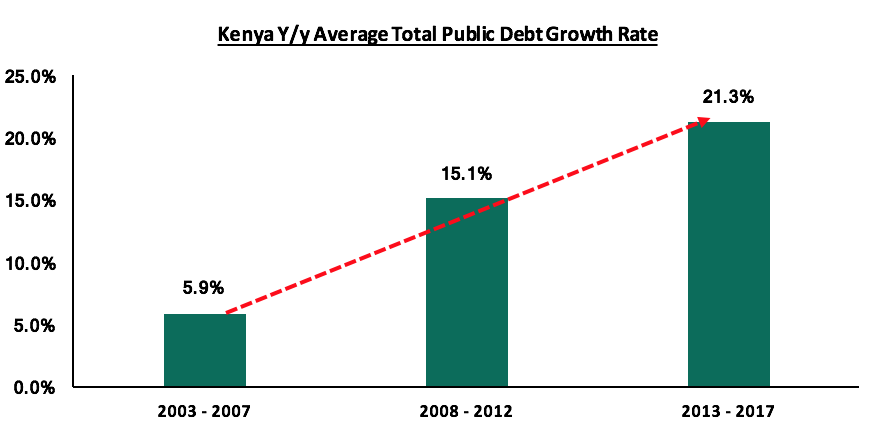
The level of Kenya's domestic debt has been steadily rising over the past two decades. For example, in 2000, the national debt was 201,463.22 million dollars; as of May 2018, it had increased to 2,447,618.88 million. There was a total of 2,220,345.35 million KES in domestic debt as of the end of 2017. The total number of shares outstanding was 1,930,855.01 million at the end of 2016, representing a growth of 14.99 percent. Rising domestic borrowing needs prompted the Treasury to issue more bills and bonds, which in turn increased the stock.
Government domestic borrowing and its impact on financial development is a topic that has both advocates and detractors. Government bond advocates say that local securities markets couldn't have grown without the government bond sector. For banks in many developing and transition nations, where financial intermediation is low, government bonds provide a safe haven. By lowering the risk for domestic banks, the security of government bonds helps to facilitate financial development.
However, those who are against increasing the national debt point out that it may stunt the growth of financial markets. To start, private investment could be stifled by a government with an excessive amount of debt. Government borrowing is detrimental to financial development because private sector bank lending is a critical indicator of financial development (Claeys et al., 2012).
The development of a global hub for financial services and the expansion of the country's capital markets were two of the most prominent initiatives in Kenya's Vision 2030, which aimed to achieve its growth objectives by the year 2030 (GOK, 2007). A globally competitive and thriving financial sector that drives high levels of savings and finances Kenya’s investment needs is the vision for financial sectors in 2030.
A specific objective has been to reduce the percentage of the population without access to financing from 85% to below 70% and to raise bank deposits from 44% to 80% of GDP. In spite of the positive developments in Kenya's financial sector, private sector credit lending fell to around 14% of GDP in 2017, while domestic borrowing by the government rose.
Since the possibility of government bankruptcy raises interest rates, a high amount of public debt may hinder the growth of regional financial markets. In developing nations like Kenya, the government borrows money from domestic banks, which hurts efficiency but makes banks more profitable. As a result, the growth rate of banks that lend to the public sector is slower.

Ibrahim Traore, a Fulfilment of a Revolutionary’s Enduring Prophecy and the Emerging Face of True Pan-Africanism

1984: Is Kenya Descending into Orwell's Dystopian world?
Kissinger Report, the Diabolical Policy Agenda to Depopulate Africa
Increasing Domestic Borrowing Starves Kenyans Access to Private Business Loans

Push for a Cashless Society Threatens More Control, Taxation, and Surveillance of the Citizens
Money Lies That Keep You in Poverty