
Victor Koech
February 8, 2024
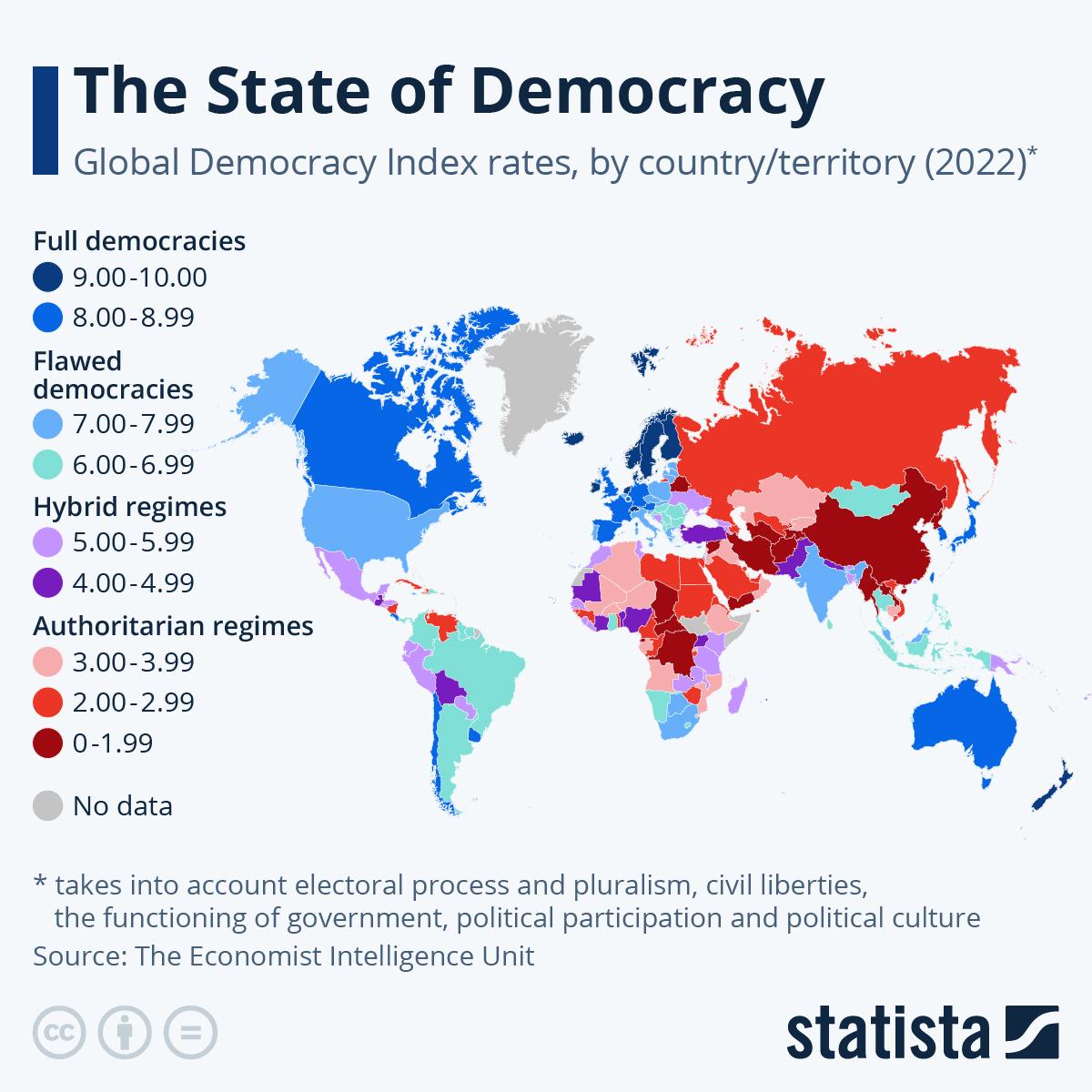
Looking back before the last three decades, there were approximately 50 democracies by the end of the 1980s. Today, there are about 150 democracies after the so-called "great conversion". We have had electoral democratic elections, and according to the Heritage Foundation, the number of countries that went from not-free market to a free-market economy quadrupled. Never in human history have so many countries abandoned whatever political-economic system they had and adopted something completely new.
Never before, all thanks to the international community, whose efforts have majorly driven the proliferation and reinforcement of westernized ideologies.
We’ve all been fed this steady diet of knowledge on how beneficial and effective structures are for organizing contemporary society politically. From all of our earlier social studies, the definition of "rule of the people, by the people, and for the people" applied to describe democracy has been ingrained into our minds. Democracy has been lauded as the most successful way of governing modern civilization.
With its conceptions dated to the early philosophical ideas preceding the development of mathematical and scientific knowledge, democracy has developed in the past two centuries to become the most dominant political model globally. To date, since the second half of the 20th century, the majority of world economies, particularly the developing nations, have adopted democratic forms of government or at least pretended to conduct some kind of democratic elections to legitimize their rule. Yet, enough information and awareness exist today in an era in which more and more members of modern society are empowered to think independently and question some of their most fundamental institutions.
And so, we should be led to consider democracy and its ideas of individual rights as perhaps another of the Western concepts pushed on to our people, including socialist regimes like China, without any altruistic intentions. A disappointing fact is that democracy has failed spectacularly in its supposed goal of civilizing the former European colonies to the status of their pioneering proponents, leading to a view of democracy as a clever tool for the neo-colonization agendas of our former colonial masters. If the most definitive metric of success for any system of organization in our society is whether it works or not, then it is worth critiquing the effectiveness of democracy as a system of political organization.
The recently concluded inauguration of our new president and the promulgation of the fifth democratic government since independence has led me to reexamine the legitimacy of democracy as the world’s most favored form of political governance. At the frontline of the inauguration stage, Paul Kagame of Rwanda and Yoweri Museveni of Uganda sat to welcome the leader of the East African Community’s (EAC) foremost economic powerhouse. These two presidents head states that are technically democratic in nature but lack the basic democratic process of changing leadership regularly (typically at four or five-year intervals) and have maintained power for many consecutive terms. Compared to many of Africa’s more democratic nations, Rwanda and Uganda are arguably more economically developed and politically stable.
So, the implication here is that what actually works in reality for a specific society as opposed to which system of governance underpins the potential for more or the most beneficial outcomes.
Now, thirty years have elapsed. We can examine the history of the great conversion. These approximately 150 democracies can be categorized first according to their socioeconomic growth and development success. This group includes around 29 nations, including Russia, that were formerly part of the Soviet Union in Europe. As the democracies with the most western economies, nations in this group were the luckiest since they were rapidly integrated into Europe and acquired access to a large market. Examining this group reveals that, with a few exceptions such as the Czech Republic and possibly Hungary and Poland, which are currently regretting their participation in the great conversion, roughly two-thirds of the countries in this group are in terrible shape, with the former Soviet Ukraine being the worst. In terms of its living conditions, Ukraine has become an uninhabitable failed state. Nonetheless, this group appears to be the luckiest.
The second group that moved to electoral democracy and market capitalism consists of regions that achieved developed world status under autocratic or dictatorial administrations. These regions include Asian economies such as Taiwan and South Korea, which became prosperous prior to embracing democracy. Thus, they did not rise under democracy, but rather under totalitarian authoritarian regimes, and they only democratized after acquiring the economic level of a first-world nation. At best, the success rate of this group is 50/50. Taiwan has declined during the past 20 to 30 years, whilst South Korea has flourished. In the latter economy, the median income has been declining and the economy is entirely stagnant, while politics has become toxic and people are unhappy.
Regarding the third group, which comprises the largest category, Latin America, Southeast Asia, and Africa represent the so-called developing world. None of the countries in this group have achieved success. It is difficult to find a single spectacular example of success.
China, whose socialist leadership has fought the transition to democracy, is, of course, the best example of the greatest success story. At first glance, one could assume that its resistance stems from ideals and cultures that are incompatible. However, the truth may be far more straightforward. Due to the pragmatic nature of the Chinese people and the fact that there hasn't been a good example of democratic rule in the last 30 years, it's likely that their government will not adopt a democratic worldview.
It therefore seems prudent to perhaps critically re-examine the role of democracy in our Kenyan society as we usher in the new democratic regime. This is to determine the extent to which the political model suits the specific needs and goals vital to our particular developing economy. Should the new government intensify the promotion of all fundamental ideals of democracy, or should it scrape them out entirely for a new political model of governance? Alternatively, could a compromise between the most promising attributes and the best practices of both democracy and socialism be struck to best serve the Kenyan people?
Ibrahim Traore, a Fulfilment of a Revolutionary’s Enduring Prophecy and the Emerging Face of True Pan-Africanism
1984: Is Kenya Descending into Orwell's Dystopian world?
Kissinger Report, the Diabolical Policy Agenda to Depopulate Africa
Increasing Domestic Borrowing Starves Kenyans Access to Private Business Loans

Push for a Cashless Society Threatens More Control, Taxation, and Surveillance of the Citizens
Money Lies That Keep You in Poverty