
Victor Koech
February 8, 2024
Looking at the bank note of two Francophone nations, Senegal and Congo, they look nothing like each other, yet they are part of the same scheme. This is a scheme that pegs both currencies to the Euro, at a rate determined by the French Treasury. The issue at stake is the apex of French policy-making, the CFA Franc.
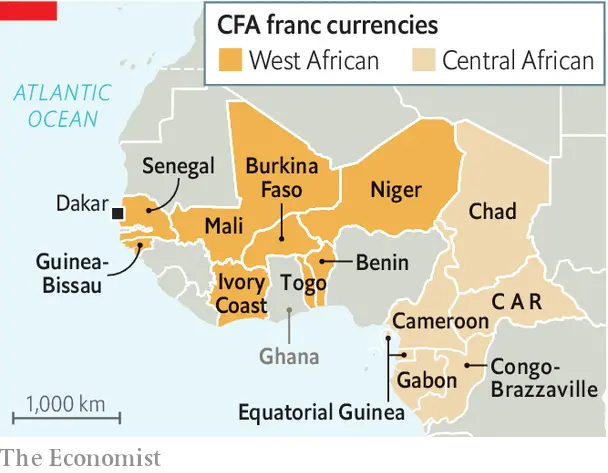
Using it, France controls the monetary sovereignty of 14 nations, making up nearly 200 million people. These countries include Benin, Burkina Faso, Togo, Cameroon, Congo, Mali, Chad, Gabon, Equatorial Guinea, Guinea Bissau, Ivory Coast, Niger, Senegal, and the Central African Republic. And while these nations have a seat at the United Nations and wave their independent flags, it is only the face of imperialism that has changed. The conduct of business has largely remained the same. The big difference is that, imperialism used to be spread through TANKS, nowadays, it comes through BANKS.
Most effective forms of control are those that are invisible. Recognizing this in 1958, France hijacked authentic decolonization by installing local collaborators and granting them statehood. These collaborators became the custodians of France’s neocolonial empire by maintaining the Franc zone and French military bases. Only Guinea turned down the offer. Its leader, Sekou Toure declared that his people preferred to be poor in freedom than rich in slavery. Guinea thus rejected the CFA Franc, seeking to develop its currency.
France felt that it needed to make an example of Guinea. So, it cut pensions to war veterans, dismantled Guinea’s power grid, and then attempted to block its UN membership. France went as far as to induce hyperinflation by flooding the country with counterfeit bills, all the while funding anti-government resistance. So yeah, it got pretty crazy. The plan ultimately failed to dislodge Sekou Toure, but Guinea’s economy never fully recovered.
Likewise, when Togo had a change of heart and sought to ditch the CFA Franc, France made another example, this time without loose ends. Togo’s leader, Sylvanus Olympio was assassinated in January, 1963. French involvement is suspected, but official records remain conveniently closed.
Of itself, further attempts to conceal French imperialism followed. The CFA Franc was split into two currencies, covering the central and west African states. By the mid-1970s, the respective central banks were Africanized and moved to Younde and Dakar. Though local Africans staffed these institutions, there were no fundamental policy changes. And France retained veto power over the banks’ governing statutes.
These included a requirement that member states deposit half their exchange reserved at the French Treasury, plus another 20% for financial liabilities; meaning member states retained access only to 30 % of their money. Moreover, all foreign exchange conversions were to pass through French Treasury. The way this fiscal policy works is by operations accounts. These are special accounts held at the French Treasury.
Denominations are in Euros, but when accounts are in credit, the African central banks effectively place their foreign exchange reserves at France’s disposal. But when the central banks’ accounts are in debit, they are obligated to pay interest to the French Treasury. In other words, CFA member states pay France to hold on to their money.
Even more unsettling, no one knows what France does with the money. The French Treasury does not disclose this information, even to CFA Franc nations. It wouldn’t thus be out of the ordinary if France was to re-invest African funding for French profit. However, one looks at it, these CFA scheme, is an effective money maker for France. And French businesses benefit as much as the French Treasury.
More specifically, France does not need to draw on its foreign exchange reserves for African imports. Dozens of French multinationals are present in Africa, including Total Energies, AREVA, and VINCI. Africa also grants France access to strategic resources such as uranium, which is indispensable for France’s nuclear energy sector – meeting three quarters of French energy needs. In all cases, the CFA Franc offers France’s guarantee of convertibility, fixed parities (then with the French Franc, today with the euro), free transferability and the centralization of foreign exchange reserves. In return, the issuance and printing of money are done in France, and the countries using the CFA Franc are obliged to deposit at least 50 percent of their foreign exchange reserves at the French Public Treasury.
Meanwhile, Gabon is a source of crude oil, Mauritania delivers irone ore, while Togo and Benin provide agricultural commodities. Additionally, the icing on the cake, French national, Vincent Bollore, owns most of West Africa’s major ports. It is thus not by incident that former French president, Jacques Chirac once stated that:
“A large part of the money in our banks comes from the exploitation of Africa. And France would lose its global standing without its African empire”
However, to preserve its hegemony, France has intervened militarily on the continent, 40 times since the 1960s; from propping up corrupt dictators, to conducting military operations in the Zaire. Furthermore, the attempts to abolish this “colonial pact” have lost the African leaders their jobs; the last one, Mamadou Tandja, was ousted in 2010 for his attempt to liberalize the market for the only raw material in his desert country, although it’s not the exclusive opinion of “radicals”. On the other hand, the messages from Hillary Clinton, ex-US Secretary of State, confirm the rumors about the real motives for the overthrowing of Muamar Gadafi in 2011, at France’s request: the Libyan leader was reaching a consensus across Africa for the creation of a continental currency guaranteed by the gold standard.
Unlike its British counterpart, which disappeared by the second half of the twentieth century, the CFA Franc remains to this day the anachronistic currency in place in 14 African countries regardless of their access to independence from France decades ago. The tremendous advantages offered to France and the strict terms and conditions of the CFA Franc explain why the currency is referred to as a tool of “monetary servitude”, the “invisible tool of Francafrique” (in reference to France’s neocolonialism in Africa) or, in an absolute plain term, the “colonial currency”.
Currently, as the world adjusts to new political and economic pacts like BRICS, the African economies under CFA Franc should utilize this opportunity effectively plan the abolishment of the currency. Given the vast disparities between African and French economies, the pegging of the region’s currency to a strong currency like the French Franc yesterday and the euro today is unnatural and has direct implications on the economic development of the CFA Franc region: reduction in liquidity when governments need it, penalties in exports, reduced the margin for central banks to intervene, which in turn makes them focused solely on fighting inflation and not economic development, the scarcity of investment money for businesses and households face prohibitive interest rates.
Under these conditions, the natural question is how sovereign can a nation be without monetary sovereignty?
This colonial currency should be eliminated because since its creation in 1945, the CFA Franc is considered as “France’s shame in Africa” and “an insult to the sovereignty of the African countries”, according to numerous experts. In a report entitled “Africa’s monetary servitude”, Le Monde Diplomatique flagged that “10 out of the 14 countries in the FCFA zone come under the category of the least developed countries (PMA) and nearly 90% of their population lives on less than two dollars per day.” Proponents of the CFA France might argue that the currency brings stability to the region. But so far, the region has not prospered, and the single currency between 14 countries did not translate into great exchanges between them.
Even more urgently, the era of the CFA Frac ought to end given the secret revealed recently by a German economic newspaper that: France receives 440 billion euros for supporting this currency and guaranteeing that it can be converted into euros without any price fluctuation, according to Deutsche Wirstschafts Nachrichten. This is a scandal which neither the African leaders nor the European Union can ignore.
Therefore, the growing unpopularity of France in Africa and the younger generation's rejection of its presence are no accident. There cannot be a French, American or British solution to Africa's challenges. Only African initiatives imagined and implemented by Africans themselves will pave the way for Africa’s awakening.

Ibrahim Traore, a Fulfilment of a Revolutionary’s Enduring Prophecy and the Emerging Face of True Pan-Africanism

1984: Is Kenya Descending into Orwell's Dystopian world?
Kissinger Report, the Diabolical Policy Agenda to Depopulate Africa
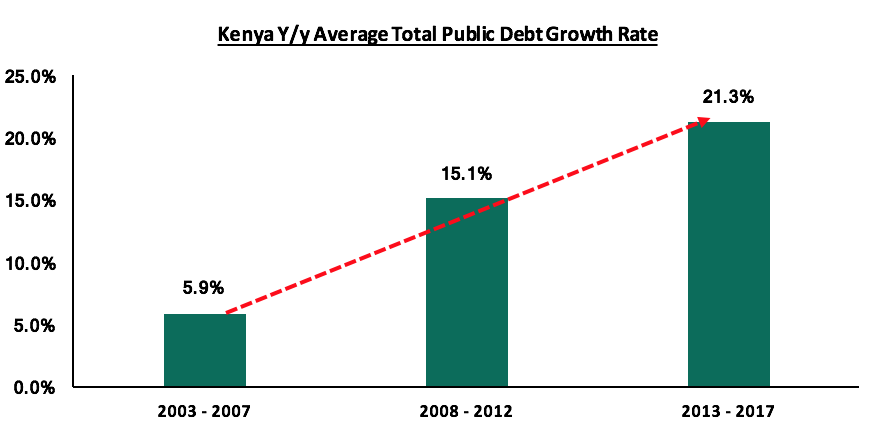
Increasing Domestic Borrowing Starves Kenyans Access to Private Business Loans

Push for a Cashless Society Threatens More Control, Taxation, and Surveillance of the Citizens
Money Lies That Keep You in Poverty