

Victor Koech
March 8, 2024
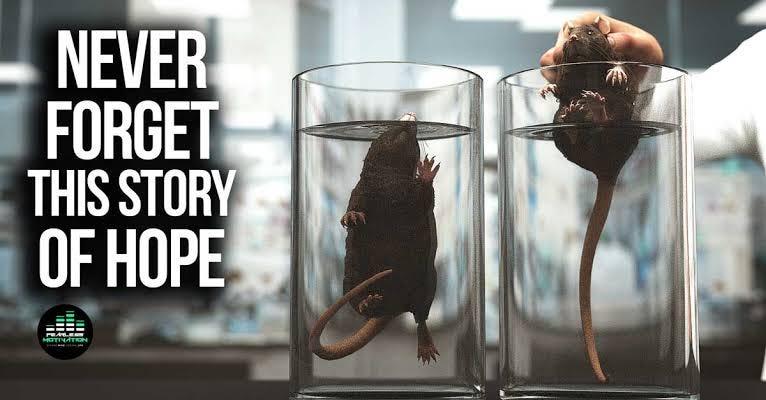
A Harvard study in 1957 by Dr. Curt Richter, placed rats in a pool to test how long they could tread water. On average due to exhaustion, they would sink and drown after 15 minutes.
However, right before they gave up due to exhaustion, the researchers would pluck them out, dry them off, let them rest for a few minutes, and put them back in for round 2! On this second try, how long do you think they lasted? Remember, they had just swum until failure only a few short minutes ago.
How long do you think? Another 15 minutes? 10 minutes? 5 minutes? NO! You are all WRONG!
It was 60 HOURS! That’s right! 60 HOURS of swimming which is 2.5 DAYS!
The conclusion drawn was that since the rats BELIEVED that they would eventually be rescued, and so they could push their bodies way past what they previously thought impossible.
Hope was the reason for this BELIEF.
On the second try, the majority of the rats expected an outside force to provide for their survival. Perhaps this is because they were fed and placed in their current situation by human hands. Somehow, they knew that intervention was feasible. They swam for their life, convinced that their condition wasn't hopeless.
On the first try, the rats had no expectations. Their perception of the world was such that assistance would not be available. They have no prior experience with glasses of water or with human interaction. They had always relied solely on themselves, and when confronted with a position from which they could not escape, they struggled little. They came to terms with their fate. The rats didn't expect to be spared. They were unfamiliar with such a concept. They died fast.
All of the rats showed a nearly equal determination to live after Richter showed them that rescue was a possibility. They were clearly in a difficult position, but not hopeless. Even in a little rodent brain, having a glimmer of hope for more life was a powerful motivator for perseverance and resilience.
Curt Richter observed that, “the sudden death phenomenon depends largely on emotional reactions to restraint or immersion comes from the observation that after elimination of the hopelessness the rats do not die.”
As a pioneering behavioral biologist, Curt Richter shed light on the idea of "learned helplessness." Although these trials were conducted on rats, the lessons acquired have far-reaching consequences for human behavior including our capacity to overcome problems with resilience.
Learned Helplessness: Richter described the rats' behavior in the first scenario, where they were left to swim until they became exhausted, as "learned helplessness." When confronted with a circumstance over which they had no control, they just gave up. This tendency is not exclusive to rats; when confronted with extended adversity, humans can learn to become despondent and passive.
Resilience and Hope: In the second scenario, the rats were retrieved from the water shortly before giving up, demonstrating the power of occasional reprieve. Even a little reprieve and glimmer of optimism could refuel their commitment. The rats in this group demonstrated resilience, emphasizing the value of hope and support in enduring adversity.
Hope is an extremely potent motivator for survival, and it may be one of the most underappreciated. If rats can keep their bodies above water for 60-80 hours because they were rescued once and believed it was still feasible, imagine the actions a human would take to save their life if they were as optimistic. Hope is necessary in the face of hardship, because without it, we are lost, just like the rats. We ought to recall the lessons Dr. Richter's rats taught us because they provide us with a much better understanding of the limits of our own endurance. If an animal expects to drown, it will. Hope motivates animals to struggle for survival.
Lessons for Overcoming Challenges
Although these trials were carried out on rats, they mirrored human responses to adversity. We, too, can feel helpless when confronted with tremendous challenges. However, the most important message from Richter's work is that resilience can be nurtured and acquired, even when hope appears to be lost.
- Recognize Learned Helplessness: Recognizing when learned helplessness is in play is the first step in overcoming problems. Understand that it is a taught response to a perceived loss of control, and that it can be reversed.
- Seek Support and Hope: Just as the rescued rats grew stronger during their brief respite, individuals can benefit greatly from seeking assistance and discovering sources of optimism. Surrounding yourself with people who care about you might give you the drive and encouragement you need to keep going.
- Break Goals Down into Manageable Steps: Just like the rats that were given time to rest and recover, setting manageable milestones can help people overcome apparently insurmountable obstacles. Breaking down a major goal into smaller, more attainable tasks creates a sensation of control.
- Learn from Setbacks: Accept failures as learning opportunities. Richter's tests demonstrate that defeats do not mean everlasting defeat. They can serve as stepping stones to greater growth and resilience.
Despite being conducted on rats, Curt Richter's experiments provide remarkable insights into the human experience. We all experience problems in life, and it sometimes feel like the odds are stacked against us. However, the lessons learned from these trials remind us that hope, perseverance, and the ability to triumph over hardship are all within grasp. With the correct mindset and assistance, we may break the cycle of learned helplessness and come out stronger from life's hardships.
I will leave you with this thought: If an Unstoppable Belief can cause exhausted rats to swim for that long, what could a Belief in yourself and your Capabilities Do for You?
Remember What you’re capable of. Remember Why you’re here. Keep swimming and Never Ever Quit.

Ibrahim Traore, a Fulfilment of a Revolutionary’s Enduring Prophecy and the Emerging Face of True Pan-Africanism

1984: Is Kenya Descending into Orwell's Dystopian world?

Kissinger Report, the Diabolical Policy Agenda to Depopulate Africa
Increasing Domestic Borrowing Starves Kenyans Access to Private Business Loans

Push for a Cashless Society Threatens More Control, Taxation, and Surveillance of the Citizens
Money Lies That Keep You in Poverty