
Victor Koech
July 30, 2024
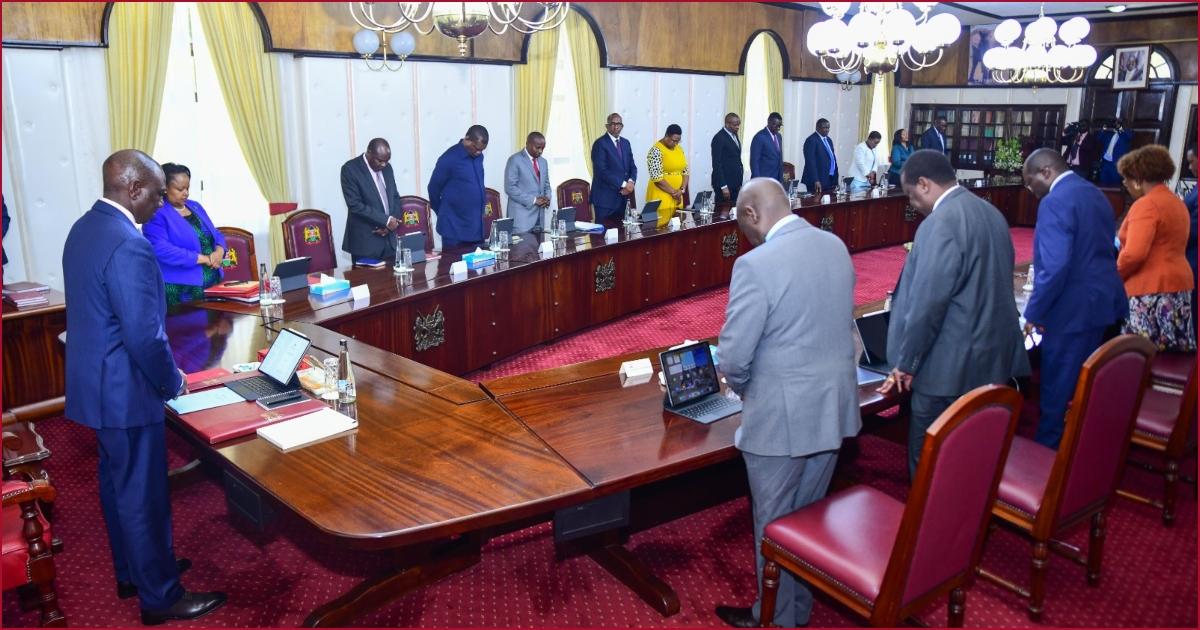
Pundits have seen President William Ruto's move to disband his whole cabinet as a ploy to salvage his waning popularity among Kenyans in addition to the pressure from Generation Z.
Ruto's daring decision to dissolve his cabinet follows a record 19 years, as the third head of state, Mwai Kibaki, did the same in 2005 shortly after 3.5 million Kenyans opposed the draft constitution.
After weeks of demonstrations, the president finally took responsibility into his own hands and fired all but one of his cabinet secretaries—Musalia Mudavadi, who was serving as prime minister and secretary of foreign affairs.
In a 12-minute address, the President justified his decision by citing contemporary political circumstances, including the "need" for broad-based governance and unprecedented popular unrest.
After careful consideration, attentive listening to Kenyans' opinions, and a comprehensive evaluation of the Cabinet's accomplishments and shortcomings, Ruto made the decision to immediately remove all Cabinet Secretaries and the Attorney General from the Cabinet of the Republic of Kenya, with the exception of the Prime Cabinet Secretary and the Cabinet Secretary for Foreign and Diaspora Affairs.
However, as a result of this action, Ruto has thrown the nation into a state of uncertainty over the subsequent events that will take place.
Kenyans currently don't know how long the embattled president will need to reassemble his cabinet. People have speculated that the president is trying to force the next "coalition government" negotiations with the opposition to come to a conclusion by not providing any dates for when he would choose his new cabinet.
So, what's next? According to The Saturday Standard, the 2010 Constitution fails to explicitly stipulate when the Head of State must create a new Cabinet after a dissolution.
The reason for this, according to constitutional expert Bobby Mkangi, is that the law requires a completely constituted Cabinet to ensure the efficient operation of the Executive at all times.
The constitution does not include any mention of Cabinet dissolution. It requires that there always be a cabinet. There is never meant to be a gap. Ruto should have kept the needed and minimal 14 Cabinet secretaries by seeking to dissolve the Cabinet to preserve continuity of administration and the country's adherence to the constitutional framework.
A cabinet shall consist of no less than 14 and no more than 22 cabinet secretaries, as per Section 152 of the Constitution.
The president has allegedly undermined the country's constitutional structure of governance, according to Mkangi, who notes that the nation is now experiencing a crisis. The Executive has yet to be entirely constituted from a structural perspective.
The President is expected to rebuild the Cabinet as quickly as feasible. We are currently in uncharted territory, and Ruto ought to uphold the Constitution by expediting the procedure. If nothing else, he should make sure that he selects the required 14 CSs and is free to fill the other seats as he sees fit.
Previously, when a president leaves office, cabinet secretaries stay to facilitate the transition and formation of a new cabinet. This should have served as guidance for him (Ruto).
On the other hand, attorney Danstan Omari maintains that no statute specifies the time frame within which the President is required to designate members of his Cabinet.
Once the names are brought before Parliament, however, the law takes effect. Since there is now no government, no policy paper can be authorized without the Cabinet. As a result, Ruto should be under pressure to form his Cabinet right once. This makes it critical that he pick his ministers.
The National Assembly is tasked for reviewing the names of the Cabinet members nominated by the President, in accordance with Parliamentary Standing Orders.
Subsequently, the Speaker is supposed to forward the nominees to the Committee on Appointments, which will evaluate the candidates' eligibility for office within a span of 14 to 28 days.
After the House team's choice is communicated to the House via a report, the President is supposed to officially appoint the CSs if the MPs approve.
It is clear that Ruto was free to re-nominate the individuals who had previously served in his Cabinet, since he had already put up his first group of candidates for ministerial positions. Nonetheless, considering the current unpopular sentiment, President ORuto should not have reappointment any among the 21 cabinet secretaries whom he dismissed.
One may make the case that the public's lack of faith in them led to their dismissal, and that rehiring them is an insult to Kenyans.
There is no question that Ruto's decision to dismiss his government was for the benefit of the nation. But because we lost several dedicated CSs, the President need to give younger professionals a chance to fill the open Cabinet posts.
There are various ramifications to the president's decision to dismiss the cabinet secretaries. They include former CSs who were forced to leave the government after 20 months without receiving their terminal benefits.
Since they were fired rather than resigned, they are considered to have forfeited their privileges under the Employment Act (Section 44). There are individuals who had obtained loans and mortgages based on their salaries and benefits; however, banks will now be required to recall these transactions. Some will no longer be eligible for the aforementioned advantages, thus they have to be surcharged and put up for auction.

Ibrahim Traore, a Fulfilment of a Revolutionary’s Enduring Prophecy and the Emerging Face of True Pan-Africanism
1984: Is Kenya Descending into Orwell's Dystopian world?
Kissinger Report, the Diabolical Policy Agenda to Depopulate Africa
Increasing Domestic Borrowing Starves Kenyans Access to Private Business Loans

Push for a Cashless Society Threatens More Control, Taxation, and Surveillance of the Citizens
Money Lies That Keep You in Poverty