
Victor Koech
September 16, 2024
What do we know, that is true, that the cult of psychiatry keeps telling us is false? First, the idea that there is known brain lesion causing mental illness. The truth is, we cannot tell who is mentally ill and who is not by looking at pictures of their brains or analyzing their blood.
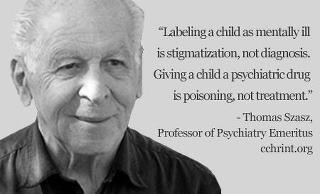
Thomas Szasz argued in The Myth of Mental Illness: Foundations of a Theory of Personal Conduct that mental disorders are just "indirect forms of communication" and that they are therefore not medical conditions that can be classified as such. Szasz's prodigious writing career spanning over 50 years would see him develop the argument he started with in this way.
Psychiatry had to invent their own book of diseases because pathologists would have nothing to do with them. It is called the Diagnostic and Statistical Manual (DSM) for Mental Disorders (DSM). It could as well be one of the greatest works of fiction of the modern age.
What is the difference between a DSM and a scientific book of diseases? Every disorder in the DSM is invented, but every disease listed in pathology textbook is discovered.
Real disease is found in a cadaver at autopsy, while mental illness is not. Mental illness refers to something that a person does, real disease refer to something a person has.
Szasz rejected the misapplication of terms like "illness" by psychiatry since he believed that these terms only applied to medical issues and its "physicalist framework," not to mental health or behavior issues. Szasz presented his views with typical iconoclasm in The Myth of Mental Illness, stating that mental ailments are "counterfeit and metaphorical illnesses" (p. 34) and that solely physical illnesses are real. He had previously argued that almost any object can have a counterfeit counterpart.
Consider this yet another way. It takes one person to have a real disease, it takes two people to have a mental illness. If you alone on an island, you could develop a real disease like heart disease or cancer, but you cannot develop mental illness such as hyperactivity or schizophrenia.
This is because mental illness is always diagnosed on the basis of some sought of social conflict. When people do something that others find objectionable, they can be diagnosed as mentally ill.
In general, illnesses are defined as deviations from a norm; in the case of physical illnesses, this norm is the body's structural or functional integrity, or a portion of it. However, the norm is far more problematic because it is a "psychosocial and ethical one," from which divergence leads to what is known as mental illness. In this situation, Szasz argues that: (1) searching for a medical cure seems ill-founded; and (2) the boundaries of diagnostic categories are inevitably somewhat arbitrary.
Moreover, if the person doing the diagnosing is more powerful than the person diagnosed, then there is trouble. In this sense, the diagnosis of mental illness is always a weapon. But, it’s not so when it comes to diagnosing real disease.
Think of how when people get angry with one other, the inevitably resort to some kind of diagnosis. They say, “you are crazy! You are mentally ill. You are paranoid.”
Can you imagine somebody getting angry with someone and saying, “you have diabetes! You have Parkinson’s disease!”
Social conflict has nothing to do with developing a real disease. You don’t develop diabetes because someone doesn’t like the way you think, speak, or behave. You have to have someone else present to judge that your behavior is morally good or bad in order to have a mental illness.
So, diagnosis is a weapon, a tool people use against one other, especially when there is some kind of power conflict present.
And what of treatment? Treatment for mental illness is punishment.
Look at the criminal justice system. When someone commits a crime, and a psychiatrist is in the courtroom, the defendant may go to a mental institution instead of a prison. Can you imagine the judge saying, “I sentence you to treatment for your cancer.”
I submit to you that psychiatric treatment is worse than prison. For in prison, they don’t judge how long people should be deprived of liberty on the basis of what they think about themselves and the world.
In mental institution of course, this is the case. If you don’t think about yourself and the world correctly, you will be punished longer.
Psychiatrists love to say that mental illness is a real disease just like cancer. However, the analogy between mental illness and real disease is not reciprocal. It doesn’t hold both ways.
Having cancer is not like being depressed. You don’t shock people who have cancer to make them better especially if they don’t want to be shocked.
Consider how melanoma, a deadly form of skin cancer is a disease in Sub-Sahara Afruca as well us in Northern India. If you have melanoma, does it cease to exists if you move to another country, another culture? Of course not.
If you are wandering the foothills of the Himalayas and meditating for 15 hours a day, you may very well be called a holy man in Tibet. Take that same person and have him work across the grounds of Washington monument ins Washington D.C. and he might well be diagnosed a paranoid schizophrenic and committed to a mental hospital.
What do you think psychiatrists would do if Jesus was alive today, or Buddha, or Mohammed. They would have them right inside a mental hospital, and injected with drugs to stop to stop their crazy beliefs and speech.
Psychiatrists today are the true grand inquisitors. They would crucify the holy men and women of yesterday in an instant.
Many Holocaust survivors who escaped Nazi Germany speak of suffering from nightmares of Nazis persecuting them, which lasted their entire lifetimes. And so, you might wonder about what people were thinking in Germany back then. I mean what were they thinking when they saw the Nazis parading about.
Evidently, nobody took them seriously. Nobody believed they could ever have the power to do what they did. Many might have even laughed at them.
While you might be encouraged to laugh in the face of those psychiatrists who argue that 2+2 doesn’t equal 4, know too that we must take them seriously. This is especially when it comes to the harm, they have done to people in the name of helping them; for if we do not, history will repeat itself.
Thus, a resistance movement is needed to be built against the psychiatric Gestapo.
Humans certainly face challenges, but I would rather think of them as "Problems in Living" rather than as sicknesses or mental illnesses. I also don't discount the importance that psychiatrists play in helping those who are struggling. While I recognize the value of psychiatrists, I believe that the ideal dynamic between a psychiatrist and patient should be one of mutual consent rather than coercion.
Perhaps even more importantly, the psychiatrist cannot legitimately claim that only he is qualified to assist those who are having problems in life because those who are having problems in their lives may legitimately ask for assistance from friends, family, clergy, mental health professionals, doctors, medications, religion, spiritual healing, marriage, and other sources.
Ibrahim Traore, a Fulfilment of a Revolutionary’s Enduring Prophecy and the Emerging Face of True Pan-Africanism

1984: Is Kenya Descending into Orwell's Dystopian world?

Kissinger Report, the Diabolical Policy Agenda to Depopulate Africa

Increasing Domestic Borrowing Starves Kenyans Access to Private Business Loans

Push for a Cashless Society Threatens More Control, Taxation, and Surveillance of the Citizens
Money Lies That Keep You in Poverty