
Victor Koech
April 22, 2024
The United Nations Security Council approved a "multinational security support mission" in Haiti on October 2 of last year, ostensibly to restore law and order and put an end to gang violence. This multinational force, which will be led by Kenya, will consist primarily of security forces from the Caribbean and Latin American regions. Although endorsed by the Security Council, this "security support mission" does not hold the status of an official United Nations mission. As opposed to receiving financial support from the United Nations, the mission will predominantly be funded by the United States, with a $200 million commitment already made.
Should this most recent military intervention come to pass, it will constitute the fourth foreign occupation of Haiti in the past three decades. The prevailing narrative disseminated by the UN Security Council, the Haitian elite, and the compliant corporate media depicts a country infested with vicious gangs. However, the actual state of affairs in Haiti, and the historical circumstances that led to that state of affairs, are considerably more intricate.
A historical perspective on the thirty years of armed interference by the United States and other Core Group members that destabilized Haiti's democracy and sovereignty is necessary to comprehend the current situation.
Anthology of foreign intervention in Haiti. Haiti, the site of the sole successful slave revolution and the first black republic, has never been permitted to flourish. Over the course of two centuries, the Haitian citizens have resisted American, British, and French invasions. Following its independence, Haiti was compelled to remit an indemnity to France in exchange for its liberation, under the perverse reasoning that the Haitian people owed reparations to their former overlords for emancipating themselves from slavery. It was not until 1947 that this debt and the accruing interest were completely repaid.
Over the last century, the United States has emerged as the principal oppressor of Haiti. During their initial 19-year occupation of Haiti (1915–34), the United States Marine Corps waged a counterinsurgency against the Haitian people that claimed the lives of at least 15,000. Three additional foreign interventions have occurred in Haiti since the 1990s: one under Clinton's administration, which involved a direct invasion, and the other two coordinated by the United Nations.
The US-backed Coup Against Jean-Bertrand Aristide
The latest United Nations occupation of Haiti commenced in 2004 subsequent to a coup d'état supported by the United States that toppled Jean-Bertrand Aristide, the nation's inaugural democratically elected leader. While this occupation persisted until 2019, the United Nations maintains an advisory presence in the nation even at present.
Throughout the 15-year United Nations occupation, referred to as MINUSTAH, systematic violence perpetrated by UN soldiers against Haitian civilians was well-documented. Furthermore, an outbreak of cholera allegedly caused by these troops was responsible for a death toll of up to 30,000. Investigations conducted by the United Nations since the conclusion of MINUSTAH have further implicated the organization in the sexual exploitation of 29 minors by MINUSTAH personnel.
The most recent decisions by the United Nations Security Council to launch an additional armed intervention in Haiti are overshadowed by this legacy. While planned governments in the Caribbean, Latin America, and Africa ostentatiously cooperate under the guise of multilateralism, the United States persists in orchestrating the oppression of the Haitian people.
Haiti's inaugural democratically elected leader, Jean-Bertrand Aristide, demanded in 2003 that France reimburse Haiti $21 billion for the indemnity it was obligated to pay subsequent to its independence. The following year, Aristide was deposed in a rebellion, and the United Nations Mission in Haiti was dispatched, ostensibly to ensure democratic and peaceful conditions. Presently observed are the tangible consequences of the MINUSTAH occupation on the ground as well as the political objectives that it truly pursued.
As a result of the United States' removal of Aristide, the Haitian state is currently in a condition of total destruction. At present, Haiti lacks any elected officials.
Systematic Destruction of the Haitian State
The United Nations and the United States invaded Haiti in 2004 with thousands of regional local officials. According to Jemima Pierre, Haiti had senators, and it also had a parliament.
Jemima Pierre, who is a Professor of African American Studies and Anthropology at UCLA and a research associate at the Centre for the Study of Race, Gender and Class at the University of Johannesburg, explained further.
She expounded that these officials have been systematically removed from Haiti since the state was dismantled. In 2004, they therefore arrived, assembled a council of elders, and established the Core Group, which consists of representatives from the Organization of American States, Spain, the European Union, and the United Nations. Since 2004, the Core Group has essentially been responsible for every political decision regarding Haiti.
They subsequently stated that they had summoned elections. In contrast, the United States financed and coerced these elections in 2011, amid the so-called Arab Spring, which followed the 300,000-fathom earthquake of 2010. Furthermore, in the initial round, the Lavalas Party, which was the most popular, was eliminated. Their participation in the elections was denied. They then dispatched three individuals. Although their candidate was a citizen of the United States, the Haitian Constitution prohibits immigrants from running for president.
They successfully overcame this obstacle by granting him a Haitian passport under the guise that he was the president of Haiti and compelling him to run for office. The individual in question was Michel Martelly.
Hillary Clinton, distraught over Martelly's failure to advance past the first round of the elections, travelled from the Middle East to Haiti, where she threatened the incumbent president with exile if the opposition refused to assist the Organisation of American States in resolving the dispute. As a consequence, the outcomes of the initial round of elections were altered, and the candidate who failed to qualify despite only 21% of the population casting ballots was purportedly declared the victor in the elections.
Consequently, as soon as Michel Martelly was appointed, the state of affairs commenced to disintegrate. Due to his failure to administer regional elections, Haiti began to lose elected officials. The nation had lost fifty percent of its elected officials by the conclusion of his corrupt and otherwise disastrous term, and he was governing by decree. Michel Martelly subsequently introduced his marionette. Furthermore, it is important to note that protests ensue continuously. Haitians have engaged in continuous protests. You cannot see that at the moment because all you can hear is gang violence.
In 2016, the United States installed Jovenel Moise under appalling circumstances, with the majority of the population abstaining from voting, using the OAS. During his tenure, regional and parliamentary elections ceased to occur. As a result, Haiti experienced a complete loss of its political leadership; by the time of Jovenel Moïse's assassination in July 2021, the state had only three elected officials remaining in office.
The assassination of Jovenel Moïse was a matter of suspicion involving the current prime minister, Ariel Henry. He is on record as having spoken with the primary conspirator of the assassination, which is a fact that I must communicate. A prime minister was absent due to the period of transition. Furthermore, the magnitude of opposition to Jovenel Moïse rendered him incapable of appointing a prime minister.
What then did the Core Group, which represents the colonizers and occupants of Haiti, accomplish?
They declared the appointment of the incoming prime minister via Twitter! The ostensible current government of Haiti was selected in this manner by the Core Group, an array of expatriates that does not include any Haitians. As a result of this initial coup d'état in 2004, Haitians have been occupied, and the Haitian state has been utterly devastated; this is the current state of affairs.
The subject matter at hand pertains to a timeline that commences in 2004 and, conceptually, concludes in 2019. This situation can be likened to the second Gulf War. Thus, it appears that, at least in the twenty-first century, the experiences of Haiti and Iraq have been relatively similar.
This experience entails the total devastation of the Haitian state at the hands of a foreign power, followed by the empowerment of local power brokers by external forces that do not act in the people's best interest. These power brokers operate with an authoritarian regime and openly disregard the rule of law, while external forces advocate for increased intervention and interference in the name of safeguarding democracy and peace.
The Demands of the Haitian People
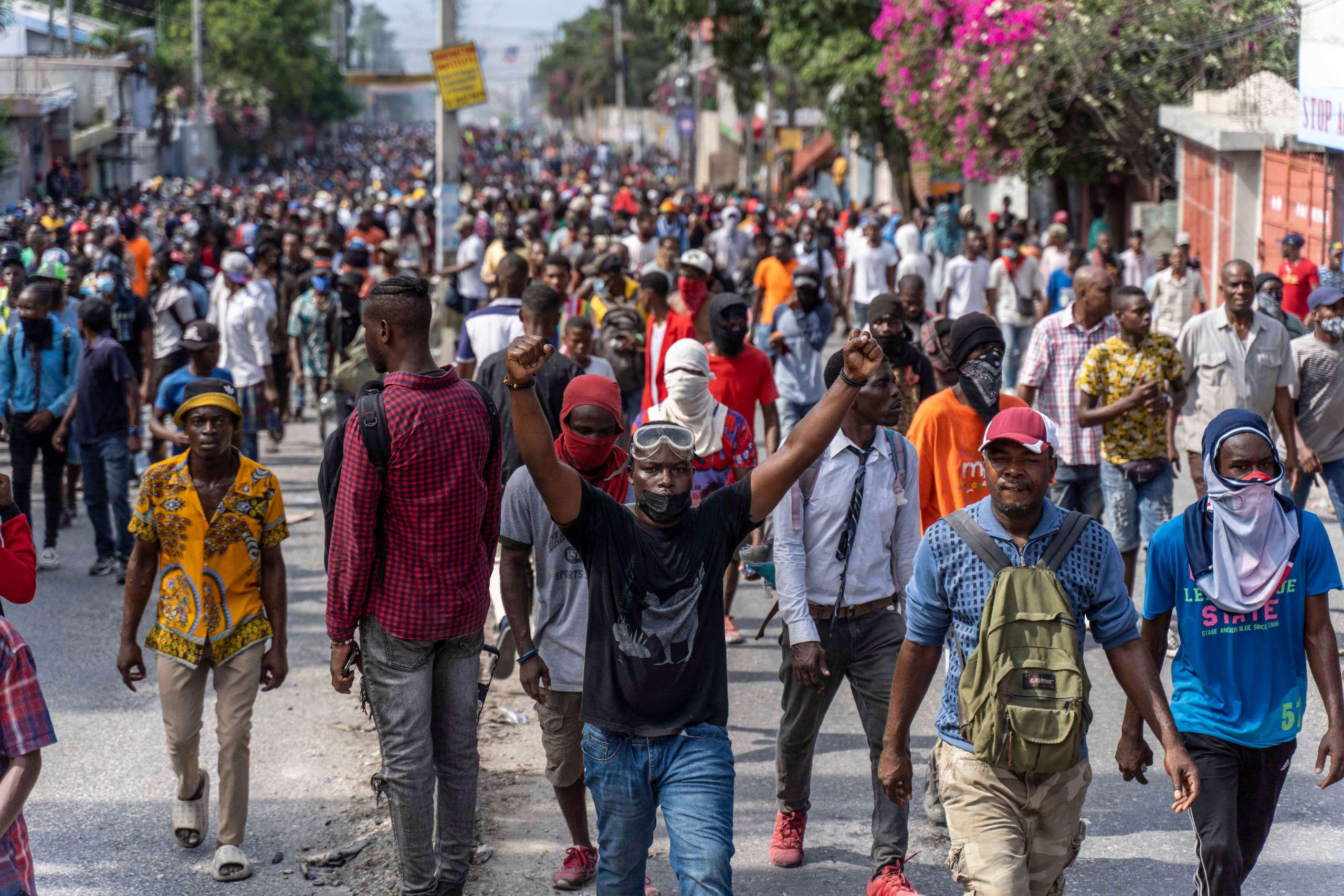
Millions of people took to the streets of Haiti between 2018 and 2019, according to Twitter, to demand that the Core Group, the United Nations, and the United States cease their intervention in the country. The Haitian populace has been engaging in peaceful protests, desiring the departure of the Core Group. Always among the initial items they have expressed. They stated that the Core Group is unnecessary.
Furthermore, what is currently of the utmost importance is their demand that the United States remove the prime minister it compelled us to have. Ariel Henry remained in power solely due to the protection provided by US special forces, which the United States maintains in a position of authority. Thus, the most important factor is that Haitians desire solitude.
The Haitian civil society convened in February 2021, bringing together numerous diverse groups that reached a consensus on a transition plan. Regarding the 2021 resolutions proposed by the community organizations, they outlined a transition period of two years. However, the United States disregarded and disregarded this period while continuing to support Henry.
People also want the United States to cease depositing arms and ammunition, as it is common knowledge that the firearms originate in both the Dominican Republic and the United States. In September of last year, a truckload of firearms and ammunition was discovered at the frontier of the Dominican Republic.
It is widely recognized that five families own every port in Haiti. The oligarchs, specifically the non-Black Haitian oligarchs who own the ports, are the ones who remunerate these young men, who operate as paramilitaries, to infiltrate and destroy residential areas. In light of this, the populace desires an arms embargo, as have been requested by China and Russia.
It is critical that people begin to notice that violence has escalated each time a United Nations vote is approaching on Haiti over the past two years. It is apparent that the media functions as a mechanism to deceitfully increase the popularity of violent topics, gangs, and the like. It is almost as if this action was premeditated to convince the international community that further attacks by foreign powers are the only way to aid Haiti.
But now, I trust, we are aware that the true problem confronting the Haitian people has been the systematic dismantlement of the Haitian state over the past three decades at the behest of the imperialist agenda. While gang violence poses a genuine risk to Haiti's efforts to regain its sovereignty, it primarily functions as a facade designed to effectively conceal the malicious schemes of its adversaries.
Ibrahim Traore, a Fulfilment of a Revolutionary’s Enduring Prophecy and the Emerging Face of True Pan-Africanism

1984: Is Kenya Descending into Orwell's Dystopian world?
Kissinger Report, the Diabolical Policy Agenda to Depopulate Africa
Increasing Domestic Borrowing Starves Kenyans Access to Private Business Loans

Push for a Cashless Society Threatens More Control, Taxation, and Surveillance of the Citizens
Money Lies That Keep You in Poverty